Springfold Paper/All plans/Dimensional scenes/2026-08
Paper Lantern Collar: Twelve Pleats on a 660 mm Band
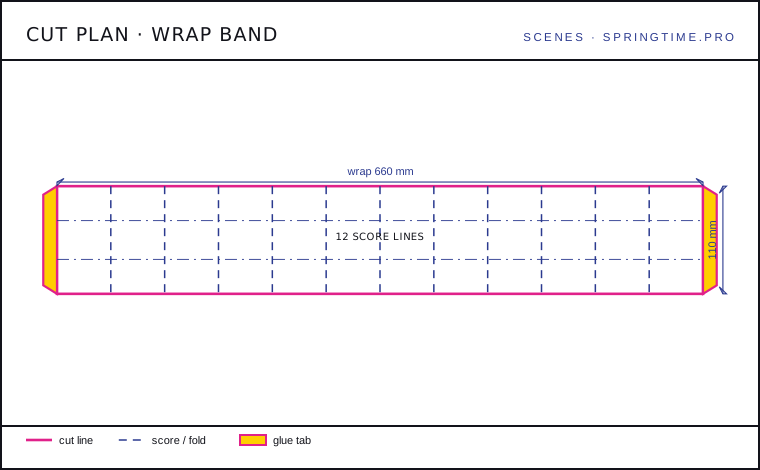
A collar is the cheapest way to change a plain paper lantern: a 660 mm band, twelve score lines, two folds — and the band is joined at 330 mm rather than cut from one long sheet, because the join is hidden under a pleat and a single 660 mm sheet is four times the price.
Join the two sheets before you score anything
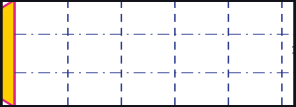
Butt the two 330 mm lengths with a 14 mm overlap and glue, then let the joint sit under a weight for twenty minutes. Scoring across a glue joint that is still soft produces a crease that drifts — the paper slides along the wet glue line and the 55 mm pitch goes out by 3 or 4 mm at the join.
Sand the joint flat on the back with 400 grit once it is dry. A 250 gsm overlap is 0.6 mm thick and on a 210 mm diameter that lump is visible from two metres.
Score at 55 mm pitch, checking the last gap
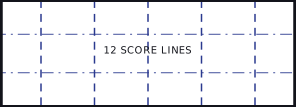
Measure and score from one end rather than stepping with the gauge twelve times. Stepping accumulates error: a 0.3 mm error per step is 3.6 mm by the twelfth line, and the last pleat ends up visibly wider than the first.
After eleven score lines you should have 55 mm left to the far edge. If you have 58 mm, re-space the last three lines rather than the whole band — the join will hide the irregularity.
Form the band around a cylinder, then pleat
Wrap the band around the 200 mm cylinder with the score lines running vertically, rubber-band it, and leave it for ten minutes. 250 gsm card takes a set from a cylinder; forming the band by hand gives an oval that never becomes a circle.
Pleat by pressing each score line against the cylinder and folding it inward 30°, working round the band twice. The first pass sets the direction, the second deepens it. Doing it in a single hard pass crushes the card at the fold and the pleat shows a white line where the surface broke.
Fold the rims inward and glue the overlap under a pleat
Fold the top and bottom 8 mm inward, all the way round, and burnish with the folder. The rims are structure, not decoration: they convert twelve separate panels into a ring that resists being squashed.
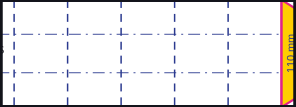
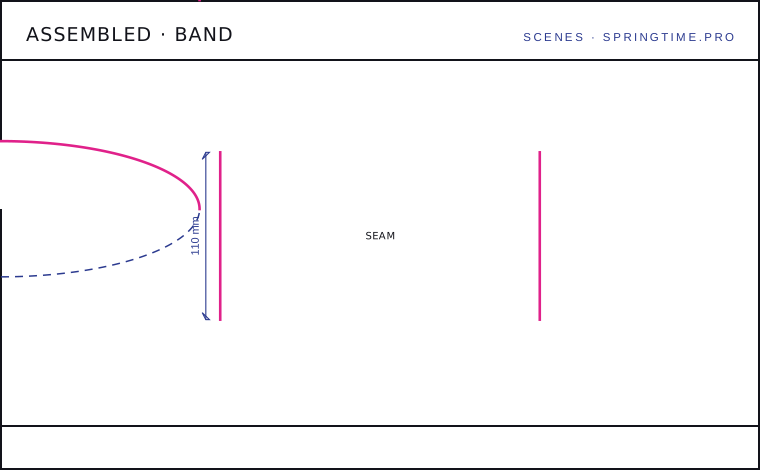
Bring the two ends together with a 14 mm overlap and position that overlap directly under one of the pleats. Glued under a pleat, the join is invisible; glued anywhere else it shows as a flat 14 mm patch on an otherwise regular circle.
Specification
| Band | 660 × 110 mm — 210 mm diameter finished |
|---|---|
| Pleats | 12 score lines at 55 mm pitch |
| Fold angle | 30° valley at each score, then opened to 22° |
| Rim | 8 mm folded inward top and bottom |
| Working time | 60 minutes, 20 of them scoring |
| Blank size | 688 x 110 mm |
| Pieces | 1 |
| Assembled | 660 mm wrap, 110 mm high |
Fold order
| Line | Kind | Angle |
|---|---|---|
| Twelve score lines at 55 mm pitch — these are the pleats | valley | 30° |
| Top and bottom rims, valley, 8 mm, folded inward | valley | 90° |
| Overlap tab, valley, 14 mm | valley | 180° |
Cut list
- One band, 660 × 110 mm — two A2 sheets joined at 330 mm
- Twelve V notches on the top edge, 55 mm pitch
- Two 8 mm rim strips scored for the inward fold
Check the plan against the object
What goes wrong
- Scoring across a wet glue joint, which puts the last two pleats out of pitch.
- Forming the band by hand. It dries as an oval and every pleat shows the error.
- Pleating with a single hard fold. 250 gsm card breaks its surface and the break shows as a white line.
Keep it clean
- Store the collar flat with a rubber band round it; left open, the pleats relax within a week.
- Paper collars are heat-sensitive. Do not put one near a bulb — 250 gsm will scorch before it visibly discolours.
- Re-pleat rather than re-glue if a pleat flattens. Glue stiffens the fold and the next one along will fail.
Also in this section
- Shadow Box Theatre: A 60 mm Carcass That Stays Square — 2026-08-18 · 120 min
- Pennant Bunting: Sixteen Flags That Hang Straight — 2026-09-07 · 45 min
- Layered Ridge Diorama: Seven Planes, 13 mm Apart — 2026-09-23 · 150 min