Springfold Paper/All plans/Paper flowers/2026-09
Cone-Rolled Calla Lily With a Rolled Throat
The calla is a single cone with one detail that decides whether it looks real: the long edge is curled back over the dowel for the last 25 mm. Get that curl and a 45-minute flower reads as a flower; skip it and you have made a paper trumpet.
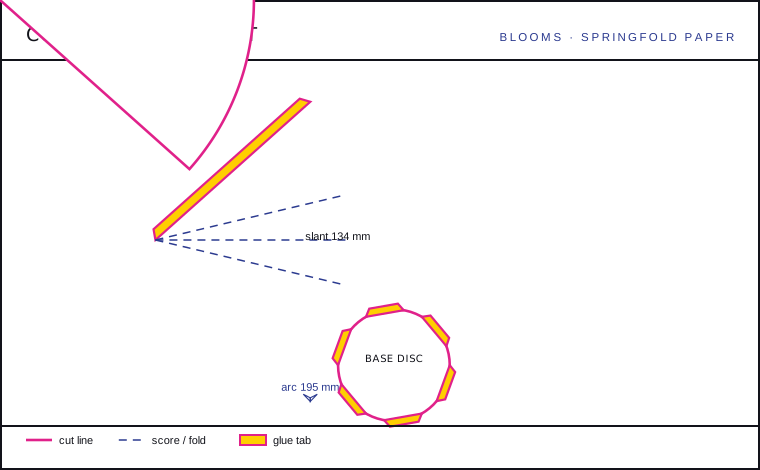
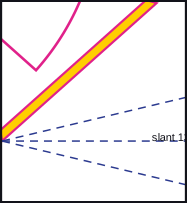
Draw the sector from the slant, not the height
The sector radius is the slant length, not the height of the finished cone: for a 62 mm mouth and a 130 mm cone the slant is 148 mm, so the compass opens to 148 mm and sweeps 218°. Sweep from the height instead and the cone comes out 20 mm short with a mouth that will not close.
Cut the sector with the paper grain running along the slant. Cut across the grain and the cone will not hold a circle — it flattens into an oval within a day, and no amount of re-rolling brings it back.
Curl the throat over a dowel before you form the cone
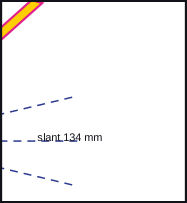
The throat curl has to be set while the card is still flat. Lay the sector face down, place the 14 mm dowel on the long straight edge, and pull the card over it with both thumbs, working from the middle outward. Hold each section for a second; card takes a curve and keeps it.
Then flip the dowel round and curl the mouth edge the other way, 6 mm deep, to flare the opening. Two opposing curves on the same piece of card is what makes the mouth of a calla look like it is opening rather than cut.
Close the roll and clamp rather than squeeze
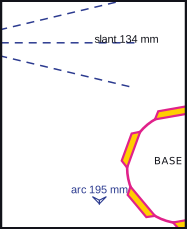
Bring the two radial edges together with a 20° overlap — 34 mm of seam — and glue with a brush along the whole length, not in dots. Hold it closed with two bulldog clips placed 40 mm in from each end. Clips squeeze evenly; fingers squeeze hardest at the tips and leave the middle of the seam open.
Roll the base disc into a shallow dome, glue the six tabs and push it into the narrow end from the inside, tabs outwards. This closes the bottom and gives the whole cone its rigidity — an unclosed calla cone collapses the first time it is handled.
Add the spadix and put the flower on a wire
Wrap the yellow 12 mm strip round the top 40 mm of the 0.9 mm wire to make the spadix, then push the wire up inside the cone so the spadix tip sits level with the mouth. Glue the wire to the base disc. The spadix should be visible but not dominant — 8 mm of it above the throat is the right proportion.
Leave the clips on for fifteen minutes before you handle the flower. Card that has been glued under tension will spring the seam open if you release it while the PVA is still white.
Specification
| Sector | 218° of a 148 mm radius, 160 gsm |
|---|---|
| Finished bloom | 62 mm at the mouth, 130 mm long |
| Overlap | 20° — about 34 mm of glued seam |
| Throat curl | Last 25 mm of the long edge, over a 14 mm dowel |
| Working time | 45 minutes, of which 15 is clamping |
| Blank size | 450 x 398 mm |
| Pieces | 2 |
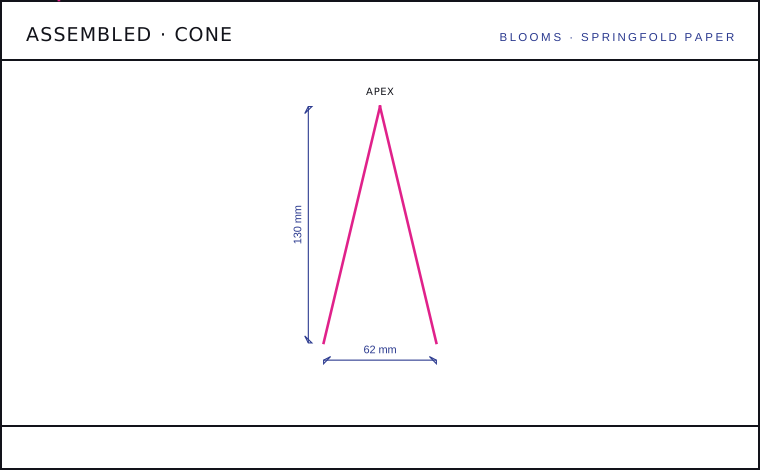
| Assembled | 62 mm base, 130 mm tall |
Shape parameters
These are the numbers the cutting plan is generated from — change one and the net is redrawn around it, so the drawing and the figures can never disagree.
| Glue tab | 6 mm |
|---|
Fold order
| Line | Kind | Angle |
|---|---|---|
| Sector edge, valley, to close the roll | valley | 20° overlap |
| Throat curl, valley, running the last 25 mm of the long edge | valley | 120° |
| Spadix spine, valley, full length | valley | 180° |
Cut list
- Wide cone sector, 218° of a 148 mm radius circle
- Base disc, with six glue tabs
- One spadix strip, 8 × 120 mm
Check the plan against the object
What goes wrong
- Drawing the sector from the cone height. The mouth ends up short and will not close around the base disc.
- Gluing the seam in dots rather than a continuous line, which leaves a visible gap exactly where the light shines through.
- Skipping the throat curl. Without it the finished piece is a card funnel, not a lily.
Keep it clean
- Calla cones dent easily. Store standing on the base disc in a box with a 70 mm hole cut in a foam block.
- If the mouth loses its flare, re-curl over the dowel before the card has been handled much — after a month the fibres will not take a new curve.
- A wipe with a dry microfibre cloth is safe on 160 gsm card; water is not, and will leave a tide mark on the seam.
Also in this section
- An Eighteen-Petal Camellia That Keeps Its Shape — 2026-08-14 · 95 min
- A Double-Ring Tissue Peony in Under an Hour — 2026-08-25 · 55 min
- Paper Eucalyptus Spray for Filler and Foliage — 2026-09-12 · 40 min