Springfold Paper/All plans/Printable templates/2026-09
Index Card File Holder: A 300 gsm Box That Stays Upright
A card file has one job — to stand up when it is full and not tip when it is empty. That is a base-weight problem, not a folding problem: this net uses a doubled base with a greyboard insert, and the sides are cut with finger scallops so a full box can be lifted off a shelf.
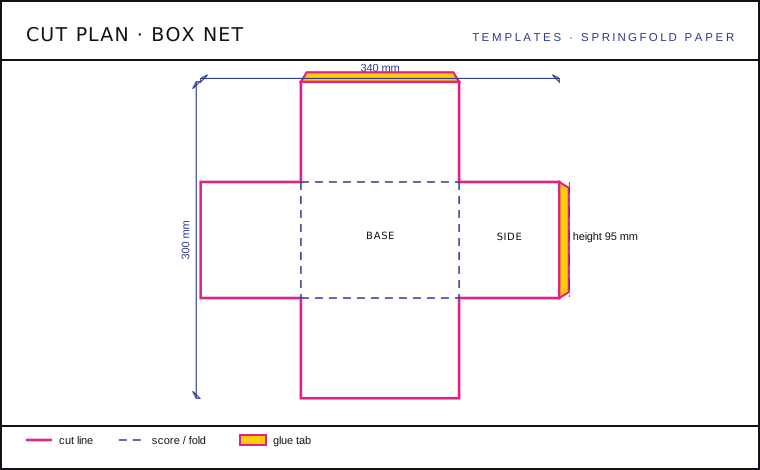
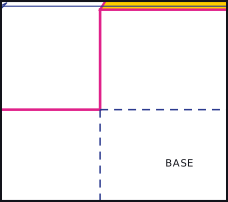
Doubled base: fold the net, then insert the greyboard
This net has an extra 110 mm panel that folds back under the base. Fold the box first, slide the 140 × 100 mm greyboard offcut in through the open base, then fold the extra panel over it. The result is a base that is 1.4 mm thick, which is what stops an empty holder tipping when the first card is dropped in.
Do not glue the greyboard. Loose, it lets the base panel move by a fraction of a millimetre as the box flexes, and a glued greyboard cracks at the corner where the box has to give.
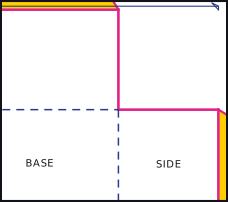
Score the front lip deeper than the walls
The 22 mm front lip folds up 90° and then the front wall folds over it, so the lip crease is folded twice in opposite directions. Score it hard — two full passes with the bone folder — or the second fold will crack the printed surface along a line that is 22 mm above the base, exactly where the eye rests.
The side scallops are cut after the walls are scored. Cut them from the inside out, 12 mm down from the top edge, and check the two match by holding the box up to a window.
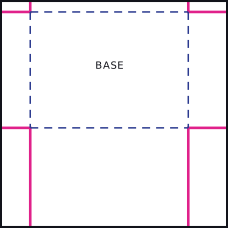
Glue the corners with the box standing on a flat surface
Assemble the box upright on a flat board rather than in the hand. Align the base corners to the board, glue the tabs, and clip. A 300 gsm box glued in the hand is always 1–2 mm out of square, and on a card file that shows as cards sitting at an angle in the holder.
Glue only three corners at first, clip for ten minutes, then do the fourth. The fourth corner is the one that lets you reach inside and press the others flat.
Cut the dividers last, from the offcut
Cut both dividers from the second A4 sheet, not from the net offcuts — offcut strips are never square enough for a 148 mm divider to sit straight in a 150 mm box. Score a 20 mm foot on each and drop them into the 5 mm registration slots.
Sand the divider edges with the 400 grit block. Index cards are thin, and a rough divider edge leaves a burr that catches the card above it every time the file is used.
Specification
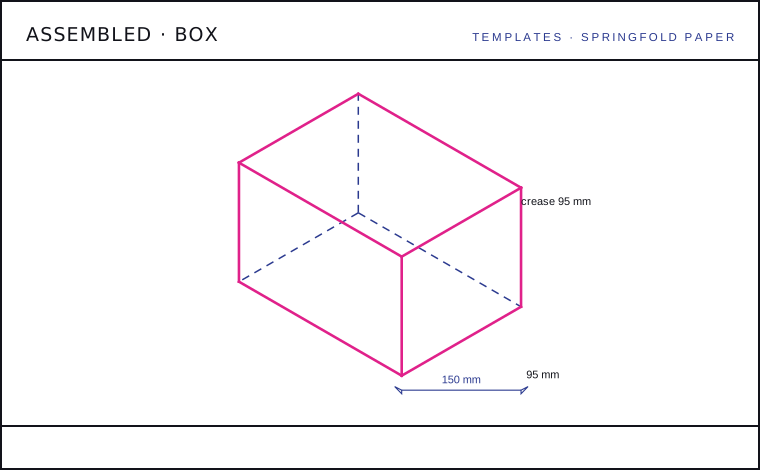
| Holder | 150 × 110 × 95 mm, holds about 180 index cards |
|---|---|
| Card | 300 gsm, doubled base with a greyboard insert |
| Front lip | 22 mm — enough to stop a full stack sliding, low enough to read the front card |
| Dividers | 2 loose, adjustable to four positions |
| Working time | 45 minutes, 15 of them clamped |
| Blank size | 358 x 318 mm |
| Pieces | 1 |
| Assembled | 150 x 110 x 95 mm |
Fold order
| Line | Kind | Angle |
|---|---|---|
| Four wall creases, mountain, folded away from the printed face | mountain | 90° |
| Front lip, valley, 22 mm — it stops the cards sliding out | valley | 90° |
| Dividers, valley, 60 mm from the base | valley | 90° |
Cut list
- One-piece net with a 22 mm front lip
- Two loose dividers, 148 × 58 mm, with a 20 mm foot
- Four 5 mm registration slots in the base for the dividers
- Two 25 mm finger scallops on the side walls
Check the plan against the object
What goes wrong
- Gluing the greyboard insert, which then cracks the box corner the first time the file is used.
- Scoring the front lip as lightly as the walls, so the second fold cracks the printed face.
- Assembling in the hand instead of on a flat board, which leaves the box 1–2 mm out of square.
Keep it clean
- Keep a 300 gsm holder out of direct sun. The lip is only 22 mm and it warps before any other part.
- Sand the divider edges again if the file is used daily; a card file's dividers take more wear than its walls.
- Do not stack anything on top — the base is doubled, the lid is not.
Also in this section
- Scored Gift Box Tray: A One-Piece Net at 250 gsm — 2026-08-21 · 25 min
- Leporello Card: 630 mm, Six Panels, One Fold Rule — 2026-09-02 · 55 min
- Cone Treat Pouch: One A4, Twenty Minutes — 2026-09-17 · 20 min