Springfold Paper/All plans/Paper flowers/2026-10
A Thirty-Two Petal Dahlia, and Why the Scallops Matter
Dahlias are distinguished from chrysanthemums by one feature: the petal tips are notched, not pointed. Thirty-two petals in four rings, each ring rotated by a quarter of a petal pitch, plus a scalloped tip you cut before the petal is separated from its stack.
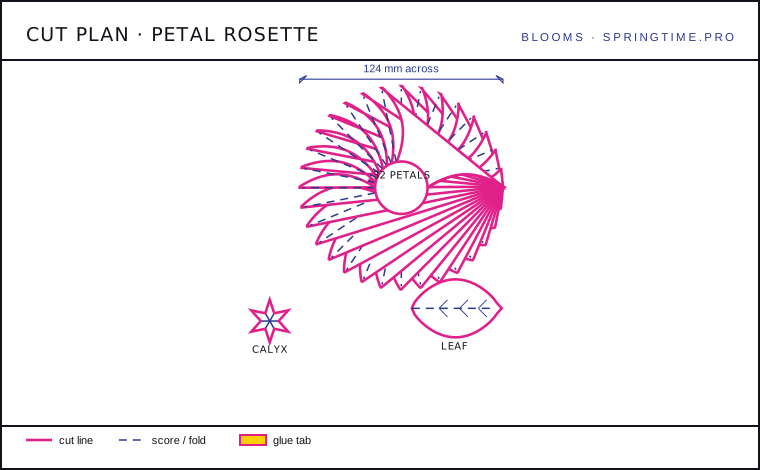
Cut eight-petal stacks and scallop the whole stack at once
Fold a 200 × 46 mm strip into a stack eight layers deep and cut the petal outline with straight scissors. Then, without unfolding, run the scalloped shears across the top of the stack once. Eight petals get identical scallops in a single cut, which is the only way to get thirty-two repeats that look deliberate.
Do this four times rather than cutting one tall stack of thirty-two. At thirty-two layers the shears push the layers out of register and the bottom petals end up with scallops 2 mm off the top ones.

Score the spine while the petals are still stacked
Slide a bone folder down the centre of the stack, once, with the stack flat on the mat. Because you are pressing through eight layers you only need light pressure; the top petal gets a clean score and the ones below get progressively lighter scores, which is exactly right — the inner rings want less of a spine.
Nothing here is folded yet. Scoring is a separate operation from folding and doing them at the same time is the most common reason petal tips curl in the wrong direction.
Curl outward, then fold the scalloped tip back
Draw the 3 mm ball from the base of each petal outward, twice. Narrow petals at 9 mm respond to the small ball and go wavy under the 8 mm one. Then turn the petal over and fold the scalloped edge back along the 3 mm mountain fold — this is what produces the notched silhouette that separates a dahlia from a chrysanthemum at a glance.
Work ring by ring and keep the rings separate on the mat. Once they are mixed, the four rings are almost impossible to tell apart by feel, and a misplaced ring shows up as a bald patch on the finished face.
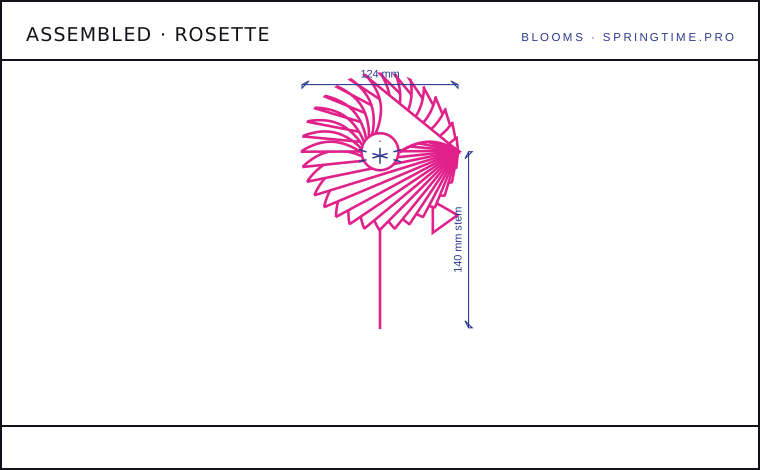
Stack the rings on a jig, then glue the backing disc
Twist the two 0.7 mm wires together into the stem and bend a 12 mm hook at the top. Thread ring four, then three, then two, then one, rotating each by a quarter of a pitch. Because the hook holds them, you can adjust every ring before any glue goes on.
Glue at the centre only, in the order you threaded them, and finish with the 40 mm backing disc, which pins all four rings at once. Without that disc the wire works through the innermost ring and the head slides down the stem within a week.
Specification
| Petals | 32 in four rings of eight |
|---|---|
| Petal size | 46 mm long, 9 mm wide — narrower than it looks |
| Scallop pitch | 5 scallops per petal at 6 mm |
| Ring rotation | A quarter of a pitch (about 5.6°) between rings |
| Working time | 130 minutes; the scallops alone are 40 of them |
| Blank size | 164 x 164 mm |
| Pieces | 34 |
| Assembled | 124 mm head on a 140 mm stem |
Shape parameters
These are the numbers the cutting plan is generated from — change one and the net is redrawn around it, so the drawing and the figures can never disagree.
| Petals | 32 |
|---|---|
| Petal length | 46 mm |
| Petal width | 9 mm |
| Petal curvature | 0.34 (0–1) |
| Disc radius | 16 mm |
| Calyx points | 6 |
| Calyx radius | 13 mm |
| Leaf length | 52 mm |
| Glue tab | 4 mm |
| Stem length | 140 mm |
Fold order
| Line | Kind | Angle |
|---|---|---|
| Petal spine, valley, stopping at the disc | valley | 165° |
| Each petal's scalloped tip, mountain, 3 mm deep | mountain | 135° |
| Calyx arms, mountain, quarter turn outward | mountain | 90° |
| Leaf spine, valley, plus a shallow cross-fold at the base | valley | 170° |
Cut list
- Thirty-two narrow petals at 46 mm, cut in four stacks of eight
- Scalloped tip on every petal — five scallops per petal, 6 mm pitch
- Six-point calyx star
- Two 52 mm leaves with 8 mm stem tails
Check the plan against the object
What goes wrong
- Cutting scallops after separating the petals, which produces thirty-two different scallop pitches.
- Using 160 gsm card. It will not take a 6 mm scallop without cracking along the cut edge.
- Threading the rings before twisting the wire hook. The rings fall off the straight wire about four times per minute.
Keep it clean
- Thirty-two thin petals are a dust trap. Blow with cold air rather than brushing.
- Store head-down in a box lined with foam so the petals hang free rather than resting on each other.
- If a ring sags, re-crease its spine rather than gluing it to the ring below — a dahlia with glued rings is a disc, not a flower.
Also in this section
- An Eighteen-Petal Camellia That Keeps Its Shape — 2026-08-14 · 95 min
- A Double-Ring Tissue Peony in Under an Hour — 2026-08-25 · 55 min
- Paper Eucalyptus Spray for Filler and Foliage — 2026-09-12 · 40 min