Springfold Paper/All plans/Paper flowers/2026-09
Quilled French Marigold: 18 Petals From One Sheet
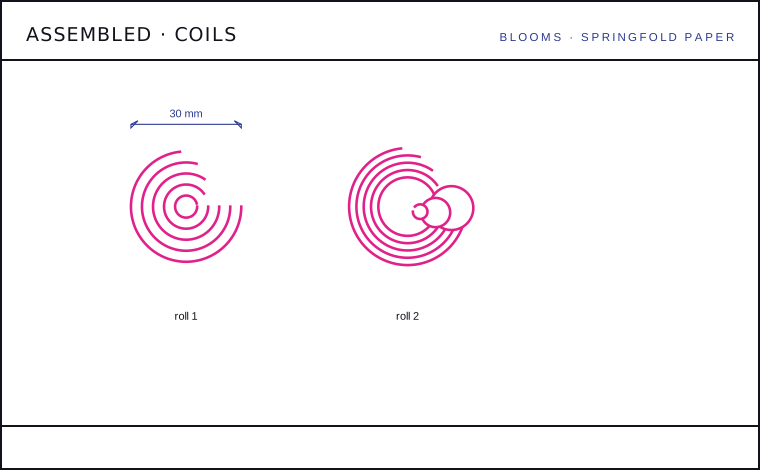
A marigold is not a flat flower, so this one is built from two coil sizes — 30 mm for the outer ring, 18 mm for the inner — with three wire-centred quills standing proud of the middle. One A4 sheet of 90 gsm paper makes the whole bloom.
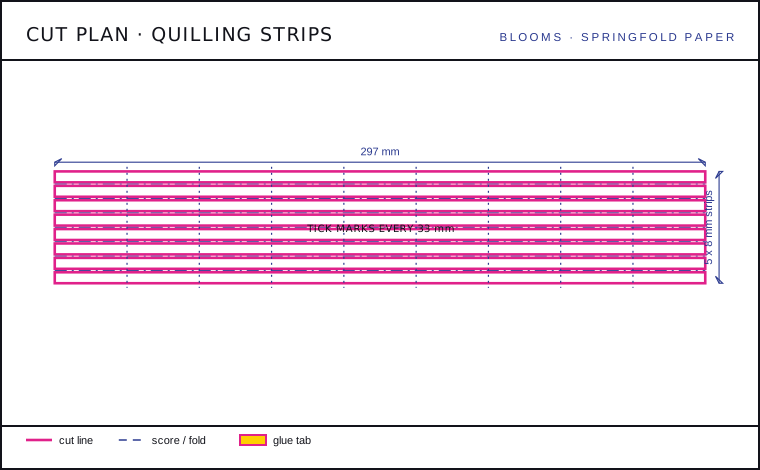
Cut strips with the grain, and count them first
Cut the A4 sheet into 5 mm strips along the long edge. Grain direction is visible if you bend a strip gently: with the grain it curves smoothly, across the grain it kinks. All fourteen strips must behave the same way or the coils will open at different rates overnight.
Cut two spare strips. The first two coils you roll in any session are throwaways — the paper has to be trained into the roll and the first attempts come out oval.
Roll, release, and let the coil find its own size
Roll 11 strips on the slotted tool with even tension, slide each off, and let it relax on the board for thirty seconds before you measure it. A coil that relaxes to 30 mm goes in the outer ring; anything that relaxes past 34 mm is too loose and should be re-rolled. Do not force the size — a squeezed coil stores tension and will push the petal out of line two days later.
When a coil has relaxed, glue the tail down with diluted PVA applied on the tip of a pin. Full-strength glue sits on the surface and stays tacky; diluted glue soaks into the paper edge and sets in about four minutes.
Pinch the outer ring into marquise shapes
Pick up each outer coil with flat tweezers and pinch it at two opposite points to make a marquise — an eye shape with points at both ends. The pinch should be firm enough that the coil holds without glue. Roughly one coil in five will buckle; set those aside and use them for the underside of the bloom where nobody looks.
The seven inner coils stay round. Round centres read as the disc of the flower, and mixing the two is what gives the bloom its depth without any additional layers.
Build on a board, not in your hand
Lay the 30 mm guide circle on the quilling board and place the eleven marquise petals around it, points outwards, butting each against the next. Glue them to each other at the touching points only — a bloom glued to a backing card cannot be lifted to adjust.
The seven round coils go inside the ring, packed so they touch the petals and each other. Three wire-centred quills sit on top of those. The calyx strip wraps the underside in a spiral working outwards, and the whole thing lifts off the board in one piece once the calyx glue has set, which takes about ten minutes.
Specification
| Strips | 14 × 5 mm × 297 mm, plus one 12 mm calyx strip |
|---|---|
| Outer coils | 11 at 30 mm, pinched to a marquise |
| Inner coils | 7 at 18 mm, left round |
| Paper | 90 gsm — at 120 gsm the 18 mm coil will not close |
| Working time | 70 minutes including 25 minutes of glue drying |
| Blank size | 297 x 51 mm |
| Pieces | 72 |
| Assembled | coils from 5 mm strips |
Shape parameters
These are the numbers the cutting plan is generated from — change one and the net is redrawn around it, so the drawing and the figures can never disagree.
| Glue tab | 4 mm |
|---|
Fold order
| Line | Kind | Angle |
|---|---|---|
| No scored folds — quilling shapes the strip by tension, not by creasing | none | — |
| Strip ends butted, not overlapped, at the join | none | — |
Cut list
- Eight 5 mm strips from one A4 sheet, cut with the grain
- Tick marks every 33 mm for splitting strips into 90 / 180 / 270 mm runs
- One 12 mm strip for the calyx wrap
Check the plan against the object
What goes wrong
- Cutting strips across the grain so half of them kink instead of curving.
- Squeezing coils down to the guide size instead of rolling them to it — the tension shows up as warping within two days.
- Using undiluted PVA. It skins over but never sets inside the coil and the petal can be pulled apart by hand.
Keep it clean
- Quilling is fragile in compression and strong in tension: store blooms in a box lined with foam, resting on the calyx, never flat on the petals.
- Keep away from steam. A kitchen windowsill will soften the coils enough that the marquise pinches open.
- A hair dryer on the cold setting, held 300 mm away, will puff dust off without touching the coils.
Also in this section
- An Eighteen-Petal Camellia That Keeps Its Shape — 2026-08-14 · 95 min
- A Double-Ring Tissue Peony in Under an Hour — 2026-08-25 · 55 min
- Paper Eucalyptus Spray for Filler and Foliage — 2026-09-12 · 40 min