Springfold Paper/All plans/Paper flowers/2026-09
Paper Eucalyptus Spray for Filler and Foliage
Every paper bouquet needs something that is not a flower. Nine round silver-dollar leaves on a stiff wire, alternating left and right, at a spacing that narrows toward the tip. Forty minutes, and it is the piece that makes the other flowers look arranged rather than collected.
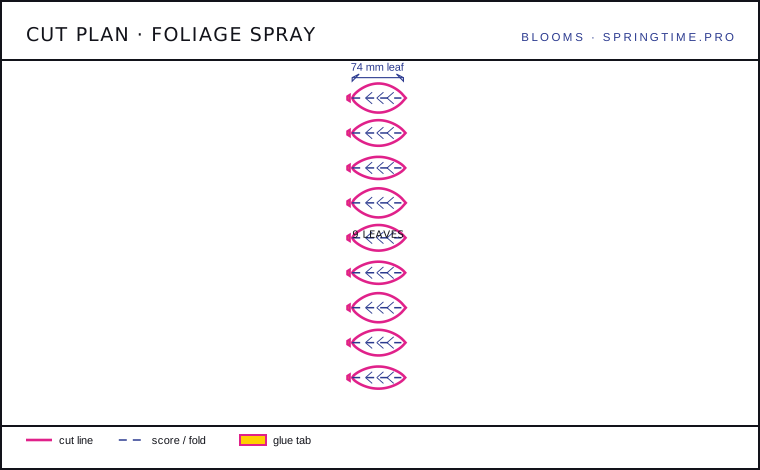

Cut nine identical leaves by stacking
A eucalyptus leaf is a circle with a pointed base. Fold a 74 mm strip into nine layers, cut the round tip freehand, then cut the base into a shallow V with a 5 mm tail. Freehand is correct here: a perfectly round tip looks stamped, and silver-dollar eucalyptus is nothing if not slightly irregular.
Keep one leaf aside as the pattern. Cut the other eight to match it loosely — within 2 mm — rather than exactly. Exact repeats are the fastest way to make paper foliage read as manufactured.

Curl only one direction, and only twice
Draw the 6 mm ball down the leaf from base to tip, twice, on the front face only. Eucalyptus leaves are flat-topped with a slight upward cup, not curls, so resist the urge to give them the same treatment as rose leaves.
The spine score is what stops the leaf folding along a random line when you wrap the tail. A leaf that has been scored down the middle will always fold there; an unscored one folds wherever the pressure falls, which on a small leaf is usually off-centre.

Wrap the tail down, not around
Hold a leaf against the wire with the tail pointing up the stem, then wind floral tape over the tail for 25 mm, going down the stem. Wrapping upward makes a lumpy joint; wrapping downward pulls the leaf tight against the wire and the tape disappears into the stem line.
Place the first three leaves at 46 mm intervals, the next three at 38 mm, the last three at 32 mm. Constant spacing is the tell of a paper spray — real foliage crowds at the growing tip.
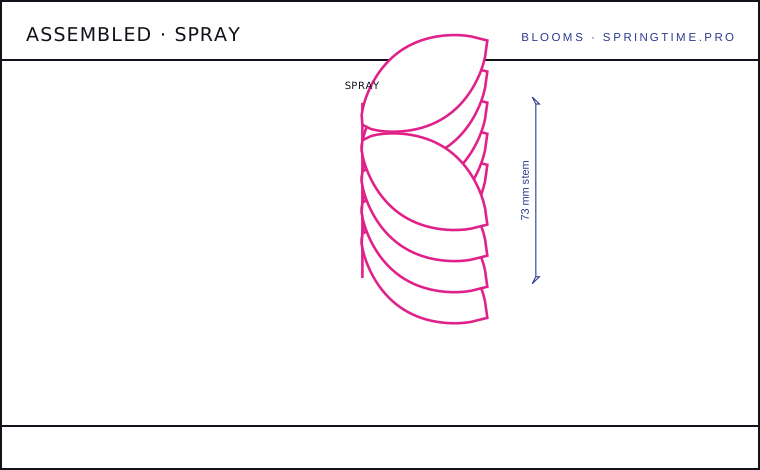
Alternate sides and finish the tip
Rotate the wire a quarter turn between every leaf so the leaves step around the stem rather than stacking. A spray built with all the leaves on one plane looks correct from exactly one angle and flat from every other.
The last leaf, at the tip, is the one that decides whether the spray looks finished. Point it straight up the stem, slightly shorter than the rest, and do not tape over its tail — a visible tip joint on filler foliage is fine and saves five minutes.
Specification
| Leaves | 9 at 74 × 21 mm, rounded tips |
|---|---|
| Spacing | 46 mm at the base, closing to 32 mm at the tip |
| Stem | 1.2 mm wire, 340 mm exposed |
| Alternation | Left, right, left — never two in a row on the same side |
| Working time | 40 minutes; 25 of those are cutting and curling |
| Blank size | 94 x 473 mm |
| Pieces | 9 |
| Assembled | 9 leaves on a 73 mm stem |
Shape parameters
These are the numbers the cutting plan is generated from — change one and the net is redrawn around it, so the drawing and the figures can never disagree.
| Leaf length | 74 mm |
|---|---|
| Glue tab | 5 mm |
| Stem length | 340 mm |
Fold order
| Line | Kind | Angle |
|---|---|---|
| Leaf spine, valley, full length | valley | 175° |
| Alternate leaves fold the opposite way so the spray reads as two-sided | valley | 175° |
| Stem tail, valley, 4 mm, wrapped round the wire | valley | 150° |
Cut list
- Nine leaves at 74 mm, cut in one stack of nine
- Rounded silver-dollar tip — no point, or it reads as a rose leaf
- Stem tails, 5 mm wide, trimmed after wrapping
Check the plan against the object
What goes wrong
- Wrapping the tape upward, which leaves a visible ridge at every leaf joint.
- Curls instead of a cup. Eucalyptus foliage should be almost flat.
- Even spacing. Real sprays crowd toward the tip and the eye notices the difference immediately.
Keep it clean
- Foliage is what gets handled when a bouquet is rearranged, so give it the stiffest wire in the arrangement.
- Store the spray hanging tip-down; laid flat, the leaves take a set in the direction of gravity.
- If a leaf tears at the tail, rewrap it with a 10 mm overlap rather than gluing — glue stiffens the joint and it will crack.
Also in this section
- An Eighteen-Petal Camellia That Keeps Its Shape — 2026-08-14 · 95 min
- A Double-Ring Tissue Peony in Under an Hour — 2026-08-25 · 55 min
- Quilled French Marigold: 18 Petals From One Sheet — 2026-09-20 · 70 min